Smoke trail
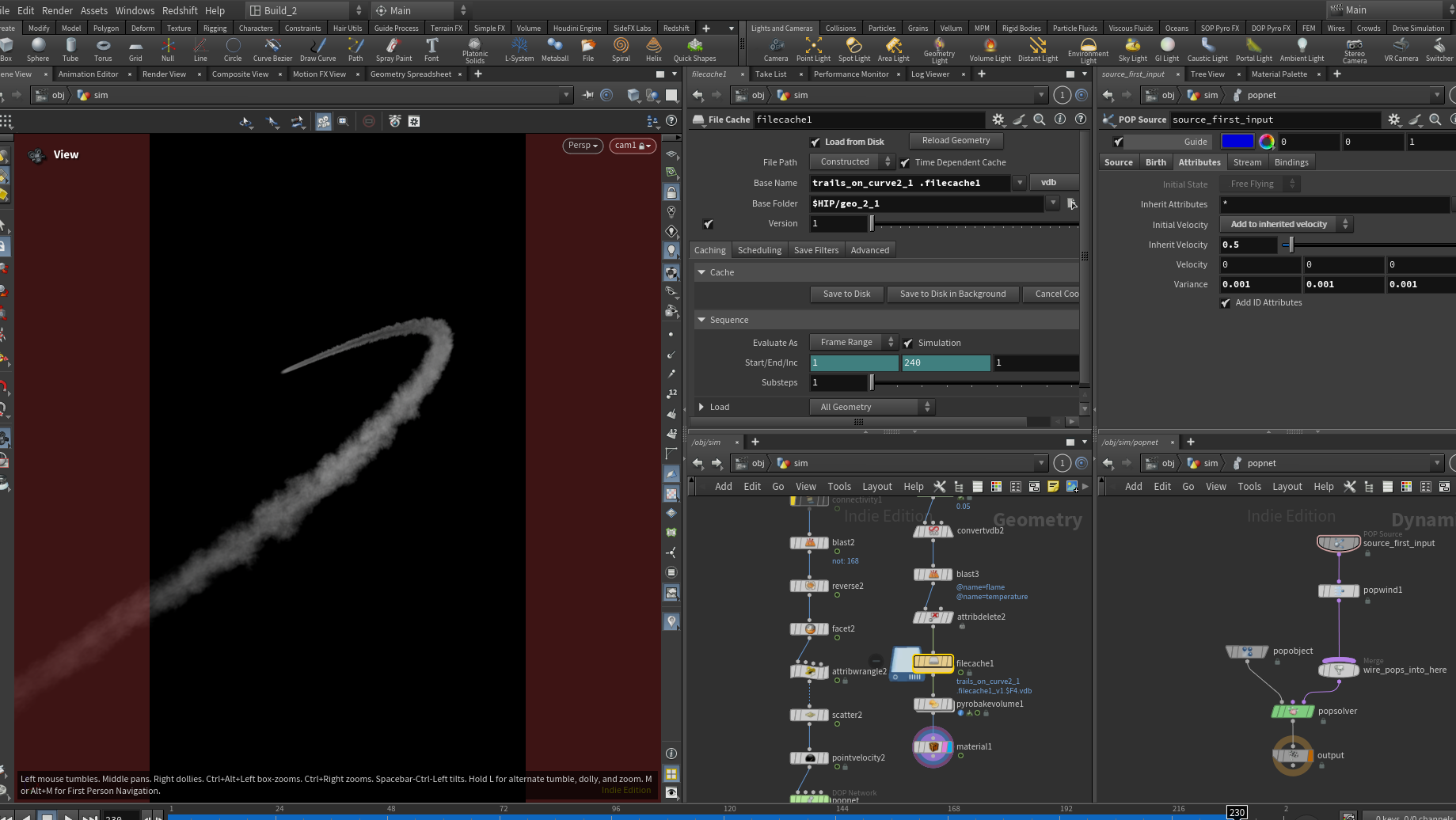
A clean smoke trail sounds simple—until you start chasing the details. This project explores a fully procedural workflow for generating a high-altitude trail with strong initial motion, natural breakup, and gradual atmospheric dissipation. After several iterations, I was able to achieve the look I had in mind
A curve was used to define the path, and a tube was deformed along it to create the trail path. After applying a PolyFill to cap thegeometry, the end face was isolated and used as the emission source for the trail.
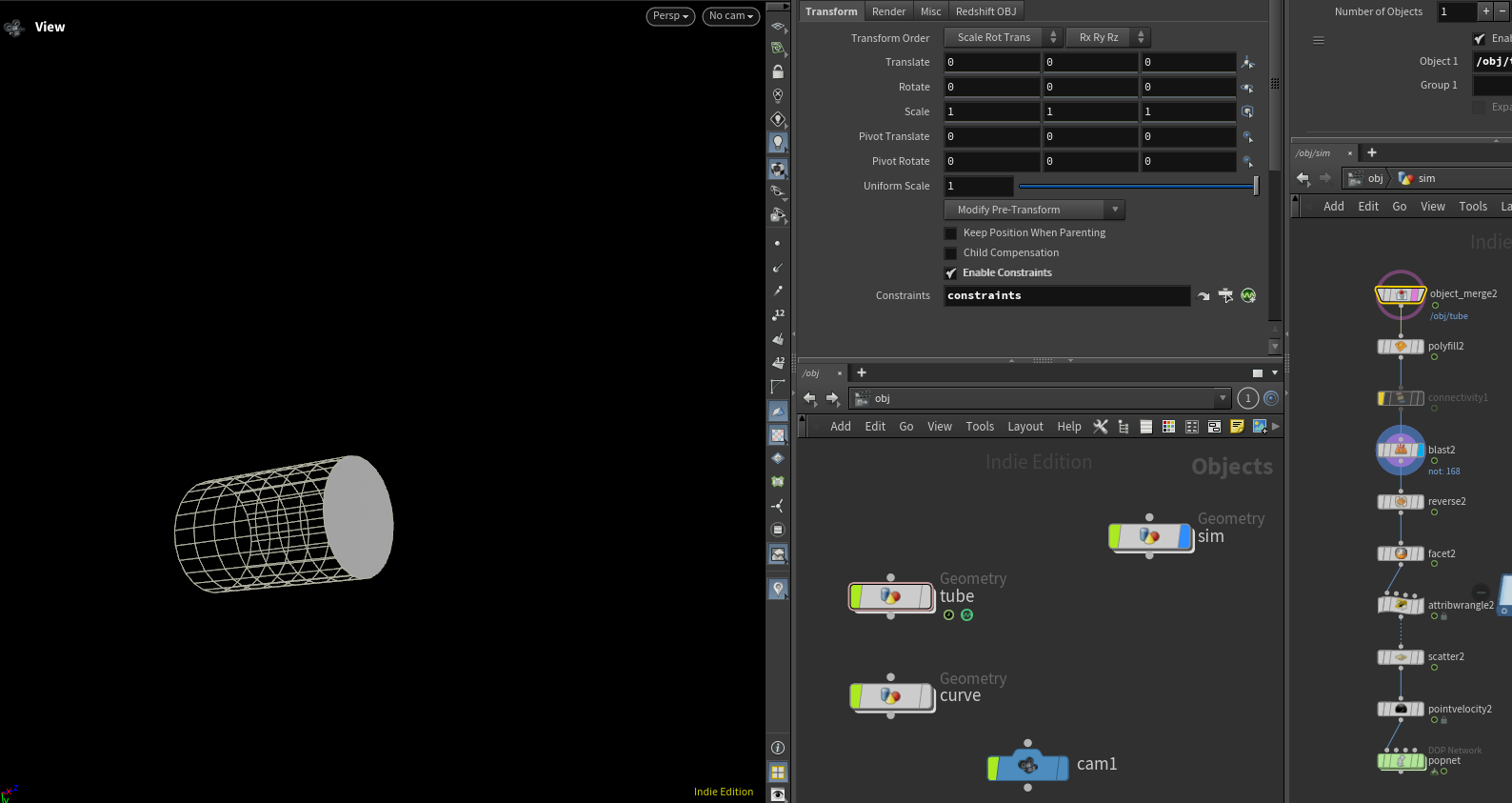
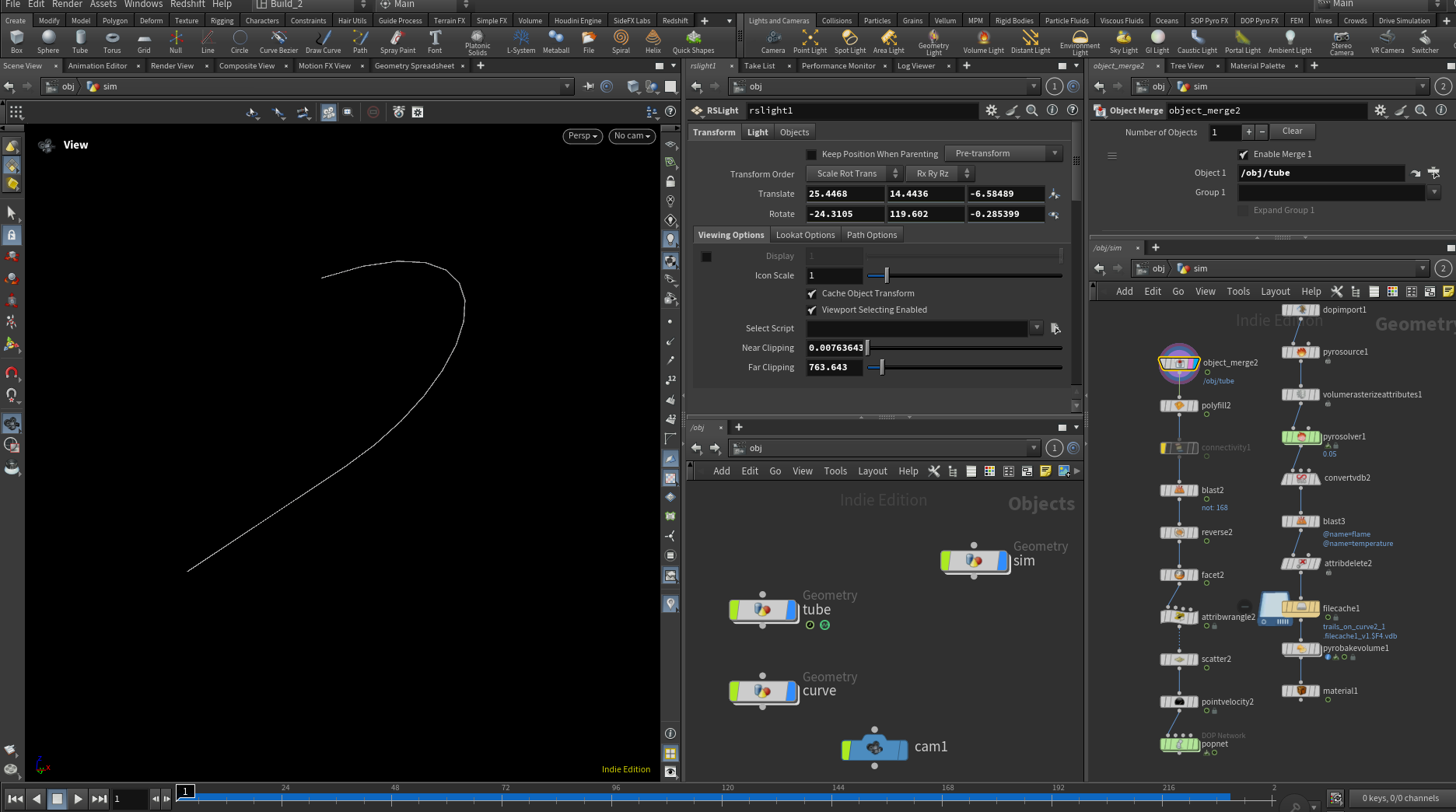
To generate outward motion, the source normals were converted into velocity vectors using an Attribute Wrangle.
By using v@v = v@N;, converted the surface normals into velocity. This gives the smoke a direction to move as soon as it is created. Instead of staying in one place, the smoke spreads outward from the source, making the trail feel bigger, softer, and more natural.
It also helps create the large-scale look often seen in high-altitude contrails and missile trails.
Additional turbulence and noise were then added to break up the uniform motion and create a more natural flow.
The points were passed through a POP Net, where particle age, drag, wind, and lifespan controlled how the trail evolved and faded overtime.
Finally, the particles were rasterized into density and velocity volumes and used to drive the Pyro simulation, resulting in a realistic smoke trail that expands, deforms, and gradually disappears into the atmosphere.
For rendering, I used Redshift and experimented with the volumeshader until I found a look that felt natural and believable while stillpreserving the details of the simulation.