Rock in Motion
A procedural Houdini workflow for creating a detailed Rock in Bottle effect, transforming basic geometry into an organic, layered structure. The process combines procedural fracturing, volumetric modeling, and VDB processing to generate natural-looking rock formations with varied shapes, gaps, and internal structures. Individual fractured pieces are processed using For-Each loop, VDB smoothing, erosion, and reshaping, while a Compiled Block improves performance during heavy volumetric operations. The workflow also incorporates custom attributes and attribute-based transparency to control material and visibility, allowing the internal structure to be revealed through the outer surface. File caching is used to efficiently manage the high-resolution geometry and computational demands of the project. The final result is a fully procedural rock-in-bottle formation that can be modified and refined while maintaining its overall structure and visual detail.
Attribute-Driven Material Layering usingcustom attributes in Houdini and Redshift.
Created an AttributeCreate node and added custom attribute called rock_mask, assigning values between 0.0and 1.0. Since 'rock_mask' is a custom attribute, enabled CustomAttribute Export at the Object level by going to /obj → Redshift Object→ Point Attributes and entering rock_mask so that Redshift explicitly exports the attribute to the renderer.
Fetch the Attribute in the Redshift Material
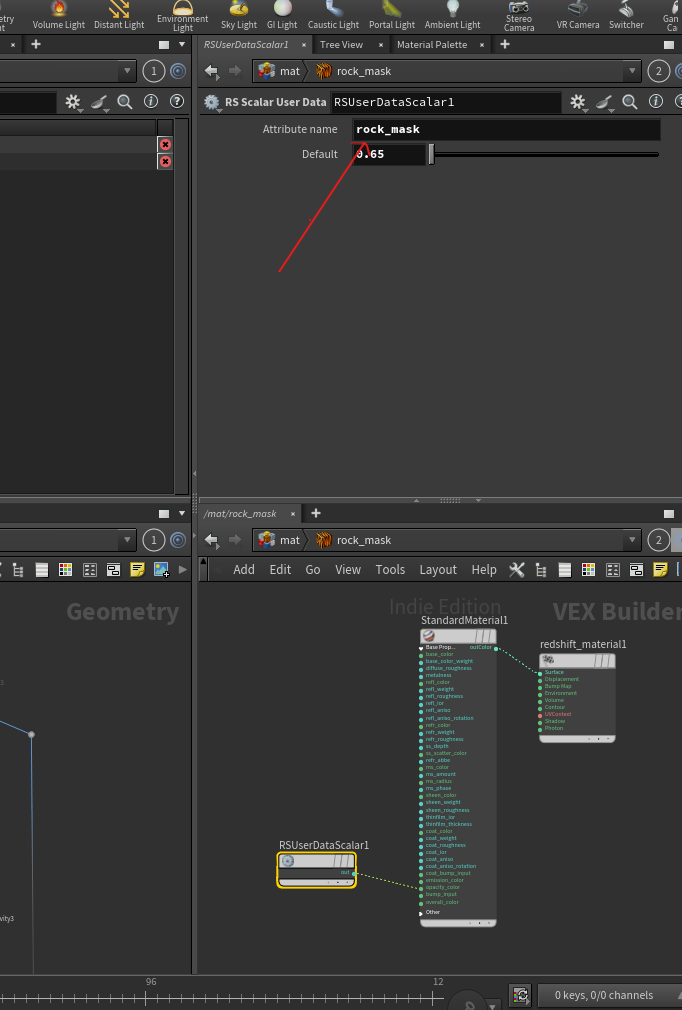
Inside the Redshift Shader Network created a RS User DataScalar node and set the Attribute Name to exactly match the SOPattribute name, rock_mask.
Plug the RS User Data Scalar (rock_mask) into the Opacity input. A value of rock_mask = 0.0 makes the material fully transparent, whilerock_mask = 1.0 makes it fully opaque.
Overall, this procedural workflow demonstrates how Houdini can transform simple geometry into a detailed and realistic rock-in-bottle effect using VDBs, fracturing, attributes, and procedural techniques.